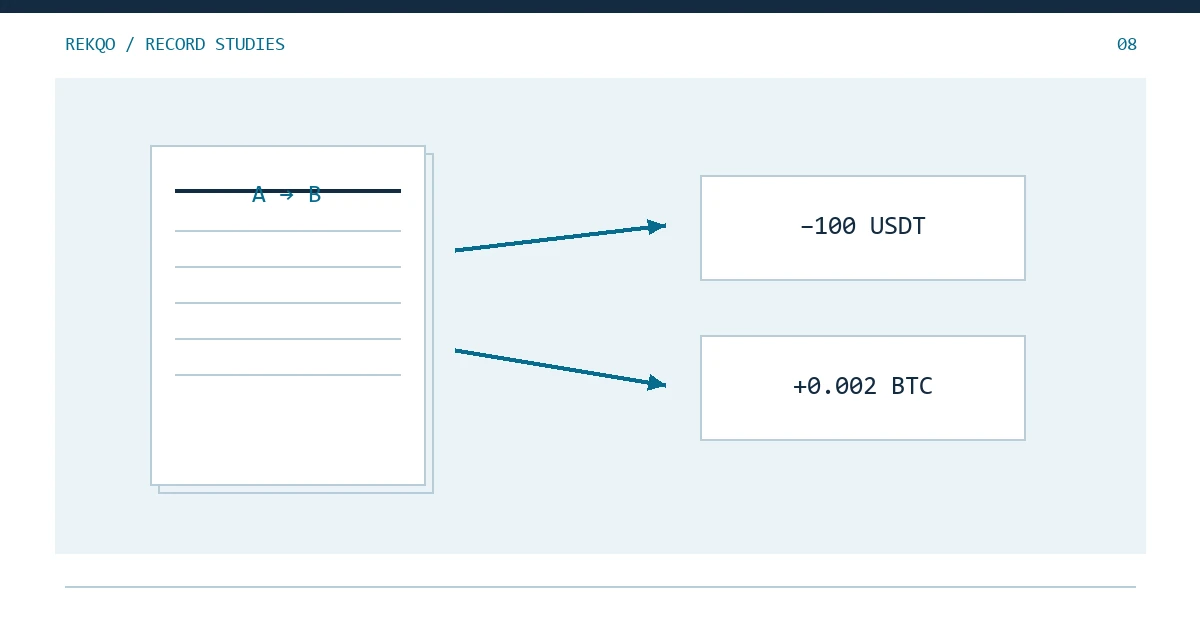
A conversion missing from a spot trade file does not establish that it never happened. Confirm the report's coverage, then check the relevant Convert history and asset movements. Different products can leave evidence in different places.
Where should you confirm the event?
Start with Convert history in the signed-in account. The Binance Convert FAQ checked for this article identifies an Orders and Convert History route. Current search ranges and available functions should be checked in your own account.
Write down the event you are looking for: approximate time, asset paid, asset received, quantities, and any available identifier. A remembered total value is a weaker starting point because prices, display precision, and valuation currencies can differ.
If the event is absent there too, review date and status filters and consider whether you used a different conversion feature. Similar actions do not necessarily belong to the same product. Do not label every asset exchange as Convert without evidence.
What should the quantity ledger explain?
It should explain the reduction in the asset paid and the increase in the asset received. Keep their units separate and connect them with an event reference.
| Asset | Before | Change | After |
|---|---|---|---|
| Asset A | 80 | −20 | 60 |
| Asset B | 3 | +2 | 5 |
Paying 20 units of A and receiving 2 units of B does not mean a loss of 18 units. The units differ. Preserve actual quantities first; any value analysis needs appropriate price evidence and separate assumptions.
A summary order and several asset movement rows can legitimately have different row counts. Compare their meaning and combined quantities rather than deleting rows to make the counts match.
Why check the source and destination wallets?
Because the two sides may appear in different wallet scopes. The official Convert material describes wallet selection and settlement; use the actual event's records to establish what happened in your account.
Keep account and wallet fields in the working sheet. If A is debited from one wallet and B credited to another, obtain both sources. An account-wide analysis can connect them, while each wallet still needs its own movements explained.
Do not relabel a Funding wallet receipt as Spot simply to close the Spot balance. Correct the coverage instead. The account scope checklist explains how to define the boundary before combining records.
Can you add a manual conversion entry?
Only with supporting evidence, and only as an explicitly documented analysis entry. A balance difference is not enough to invent a conversion and present it as a platform record.
If an official detail record is available but a suitable export is not, retain a private summary of its time, quantities, assets, wallet scope, status, and evidence location. Mark it as a supplementary source so a later export does not count the same event again.
If you know a conversion occurred but cannot establish the quantities, keep a pending issue. Other fees, rewards, or movements might explain some of the balance difference. A convenient balancing number is not a substitute for the missing detail.
How do you avoid counting the supplement twice?
Check whether the asset history already includes the quantity changes. Product details may explain entries without needing to add another set of movements.
One approach is to use asset history as the quantity source and Convert detail as the event explanation, linked by a supported reference. Add missing movements only where the evidence establishes that they are absent. Document which source calculates and which source explains.
Then reconcile both affected assets. Checking only the received asset can hide a problem on the paid side, while checking only total market value may obscure a quantity error behind price changes.
What if the event is still processing?
Retain the observation time and actual status rather than treating an expected result as a completed credit. The official Convert explanation notes that some activity may settle in parts; the individual order determines the relevant evidence.
For activity crossing month-end, separate the order's creation time from asset changes that have actually occurred. Do not put a complete expected result into the earlier month merely to make the order look finished in one step.
When a later status arrives, preserve the new version and identify the additional confirmed movements. If support is required, provide the product, period, and necessary identifiers through an official channel. You do not need to disclose an entire ledger or verification secrets to investigate one item.
Does a saved quote prove a conversion?
No. Viewing a quote, submitting a request, and completing an exchange are different stages. Use confirmed activity and asset movement evidence for the ledger.
A quote screenshot can show what you were offered, but may not show that you accepted or completed it. Check history and related balances before recording received assets. Do not fill missing execution values using a later market price.
For canceled or unfinished requests, preserve the useful status without inventing movements. If a portion actually settled, document that supported portion and keep the remaining status distinct. The item is reconciled when both asset changes have traceable sources and supplementary details have not created duplicate counting.