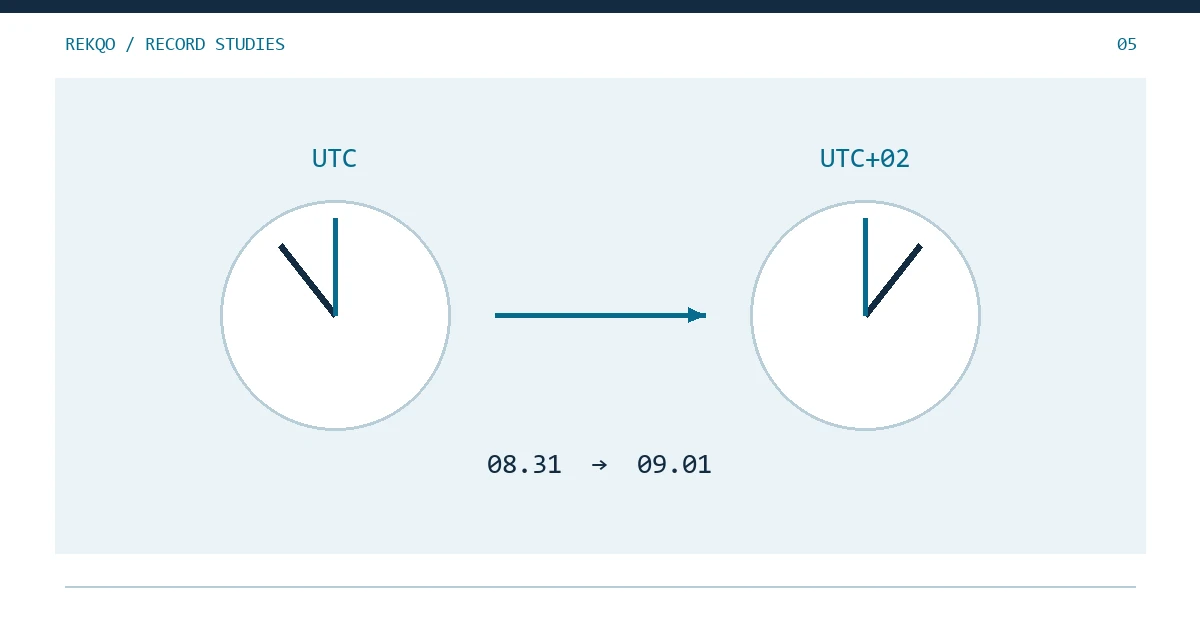
A file says August 31 in the evening, while the account page shows September 1 in the morning. Both can describe the same moment. Check the time zone before concluding that the export is a day late or missing records.
How do you establish that it is a time-zone difference?
First match the event using asset, direction, quantity, and available identifiers. A whole-hour difference alone does not prove that two records refer to the same activity.
In a fictional example, August 31 at 22:30 UTC corresponds to September 1 at 06:30 in a fixed UTC+08:00 offset. The date differs; the moment does not. A ledger grouped by UTC places it in August, while one grouped by that local offset places it in September. Choose the basis required by your task and apply it consistently.
Keep any time-zone label supplied by the file. Recap's instructions list a particular Binance statement format with a UTC_Time field. That helps interpret that format, but it does not establish the headers or display conventions of every Binance product export.
Which time columns should a working sheet retain?
Preserve the original text, identify its time basis, and add a converted column for reconciliation. A convenient local display can be another column rather than a replacement.
| Field | Purpose |
|---|---|
| Original text | Preserve the file's evidence |
| Original time basis | Explain the represented moment |
| Reconciliation time | Use the ledger's chosen boundary |
| Local display | Assist comparison with the interface |
If a file does not specify its time zone, do not automatically apply the computer's current setting. Look for report documentation, account display settings, or a known event with a reliable time reference. Mark unresolved cases before relying on a cross-day merge.
Why not add the same number of hours all year?
Some geographical time zones change their offset during the year. A named zone and a fixed offset are different concepts.
For historical conversions, use a method that handles the actual dates and check samples around clock changes. Some local times can repeat or fail to occur during an adjustment. Original offsets or an unambiguous time standard help preserve the distinction.
You do not need to edit the original to investigate. Test a few rows in a copy and confirm their ordering against associated events. Applying today's offset to every historical date can create errors that are hard to notice away from a month boundary.
How should the month boundary be written?
Write full start and end conditions with a time basis and an inclusion rule. “August” alone does not tell you where the day begins.
For local analysis, one convention is to include August 1 at 00:00 and exclude September 1 at 00:00. The next period begins at that same September boundary. Verify the platform's selector separately; your worksheet convention is not evidence of its implementation.
Extra neighboring-day records can be useful for checking, but treat them as boundary evidence until the unified-time filter decides whether they belong. Downloading an extra day should not mean counting an extra day.
What if the dates still disagree?
Check the meaning of each time field and the way the file was read. Creation, execution, credit, and status-update times can represent different stages of an event.
If the page shows completion time and the file shows creation time, crossing midnight may be legitimate. Consult field descriptions before selecting the appropriate time for your task. Do not overwrite one timestamp just to make both displays agree.
Also inspect date parsing. A day-month ordering mistake can swap September 8 and August 9; that is not a time-zone problem. Revisit the untouched text and import it with an explicit format.
What final samples should you check?
Check an event near the beginning, one near the end, and one within the period. Confirm the relationship between original time, converted time, and period assignment.
Keep the conversion rule and unresolved fields in the index. If you share results, attach the boundary note because another person's software may display times using a different local setting. Clear original columns prevent an ordinary display conversion from looking like altered evidence.
Does missing second-level precision matter?
It can affect ordering and duplicate decisions. Preserve the precision actually supplied; do not invent seconds for a minute-level record.
If an official detail page provides more precision, retain it as a separately sourced observation. Two rows with the same displayed minute can still be distinct events. Use identifiers and quantity relationships where available, and keep uncertainty where finer evidence is absent.
Finally, separate file-generation time from event time. A report created on September 1 can contain August activity. If a time difference remains unexplained, hold the affected records as a specific pending boundary issue instead of moving them between months merely to close the totals.