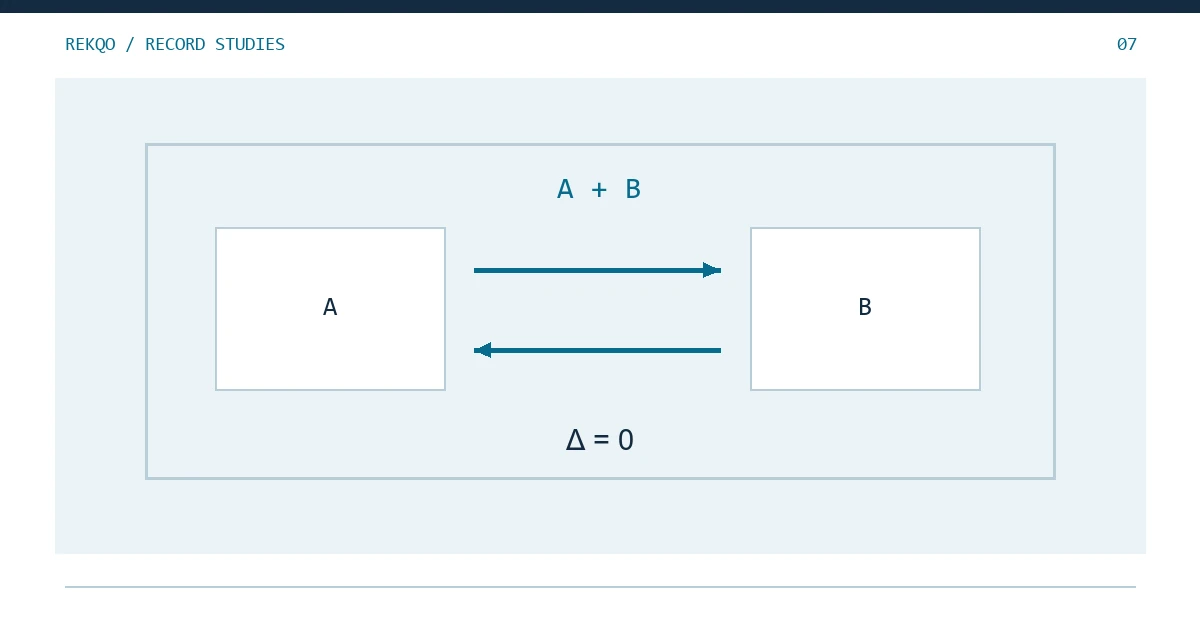
Money moves between two wallets several times, and the ledger's “income” grows even though no funds entered from outside. The likely question is whether receipts were classified as new income without considering the account boundary.
Define the boundary before calling a movement internal
An internal movement stays within the scope you are reconciling. The word is relative to your ledger, not determined solely by a platform label.
If wallets A and B are included, A sending to B is internal to the combined scope. If only B is included, the receipt crosses B's boundary and belongs in its inflows. Both views can be valid, but they must not be mixed in one unexplained total.
Ownership and coverage are also different. A wallet you control may still be outside this reconciliation if its records are excluded. List included and excluded accounts before pairing movements.
What happens to the combined quantity?
| Location | Before | Movement | After |
|---|---|---|---|
| Wallet A | 300 | −50 | 250 |
| Wallet B | 20 | +50 | 70 |
| Combined | 320 | 0 | 320 |
Counting B's 50 as new income while ignoring A's reduction overstates the combined position. Keep both records and identify their relationship; cancel the internal effect only in the relevant combined analysis.
This does not mean deleting the original rows. They explain the separate wallet balances and preserve the path taken by the asset.
How can the two sides be matched reliably?
Combine account direction, asset, quantity, time, and available identifiers. Equal amounts and nearby times identify candidates, not definite pairs.
Several same-size transfers can occur on one day. Matching on amount alone may connect the first outgoing entry to the second incoming entry, making the intermediate position confusing.
Add an association reference and status in the working sheet, preserving original fields. Document the evidence for a confirmed pair. Do not change one timestamp to force equality; creation and credit times may represent different stages.
What if outgoing and incoming quantities differ?
Investigate explicit fees, grouped entries, unit differences, and missing scope before explaining the gap.
If a fictional source shows a total deduction of 10.2 units and the destination receives 10, only documented evidence can establish whether 0.2 is a fee. Without that evidence, leave it as an unresolved quantity rather than automatically classifying it.
A single outgoing entry may correspond to multiple incoming records, but quantity totals alone are not enough to prove that relationship. Time, identifiers, or product detail should support it. Movements in two different assets may indicate a conversion rather than a transfer, even if their estimated values are similar.
How should a pair crossing month-end be handled?
Keep each actual record time and mark the relationship as cross-period. Do not move next month's credit backward merely to eliminate this month's apparent difference.
Where the wider scope contains an unfinished movement, use the available records to describe its intermediate status. A simple quantity formula may not explain every pending item. Keep the limitation visible and identify the additional evidence required.
When the other side arrives, update the association and resolution date while preserving the original files. The explanation should connect months without counting an event in both.
Why not label every positive entry income?
A receipt describes direction; income describes a business classification. Internal movements, owner contributions, refunds, and rewards can all appear as positive quantities with different meanings.
During quantity reconciliation, use the neutral term “inflow” and refine categories as evidence becomes available. An unexplained receipt can remain pending. A personal label also does not automatically determine tax treatment.
If software already uses “income,” check its definition. The display may simply mean assets received, without making the wider economic judgment you assume.
How do multiple reports create double counting?
A transfer report, asset history, and wallet record may describe the same movement. Choose the quantity source and use the others as supporting evidence.
If asset history already contains A's deduction and B's increase, a separate transfer report can help pair them without adding another set of entries. Even duplicated positive and negative rows that sum to zero can inflate activity counts and gross flows.
Document each file's role before adoption. Retaining every original does not require adding every row from every source to the cumulative analysis.
Does a scope change affect old pairs?
Yes. The evidence remains, but a movement's classification relative to the boundary may change.
In a fictional first version covering only A, the 50 sent to B is an outflow. In a second version that includes B, it can be internal to the combined scope. Keep the first result and explain the wider second scope rather than erasing the earlier reasoning.
When comparing external flows across months, use consistent coverage or identify the difference. Adding wallets can change the reported flow pattern without changing the person's actual behavior.
What should be checked after pairing?
Check each wallet as well as the combined scope. A correct combined quantity can hide an incorrectly assigned location.
- Every confirmed pair has traceable endpoint evidence.
- Unmatched entries remain visible.
- Any supported fee is distinguished from transferred quantity.
- Cross-period items have clear status.
- Supporting reports are not counted again.
If one wallet still differs, review account labels and direction even when the combined effect is zero. The ledger should explain both how much exists in scope and where it is located.
What if one account's records are unavailable?
State the limited conclusion precisely: “A's outgoing entry found; B's records excluded; the pair remains unconfirmed.” This does not prove lost assets or a fully checked internal transfer.
Specify the next retrieval task by account, period, and asset. A vague balancing adjustment would hide the same unresolved opening difference in later months.
What does an internal adjustment label prove?
Read its definition and source. Software may use “adjustment” for an analysis change rather than an actual platform movement.
Separate original activity from your classifications or scope corrections. Ask whether the entry exists in a platform source and whether the relevant quantity actually changed. If those questions remain unanswered, do not invent an event time and amount merely to support the label.